
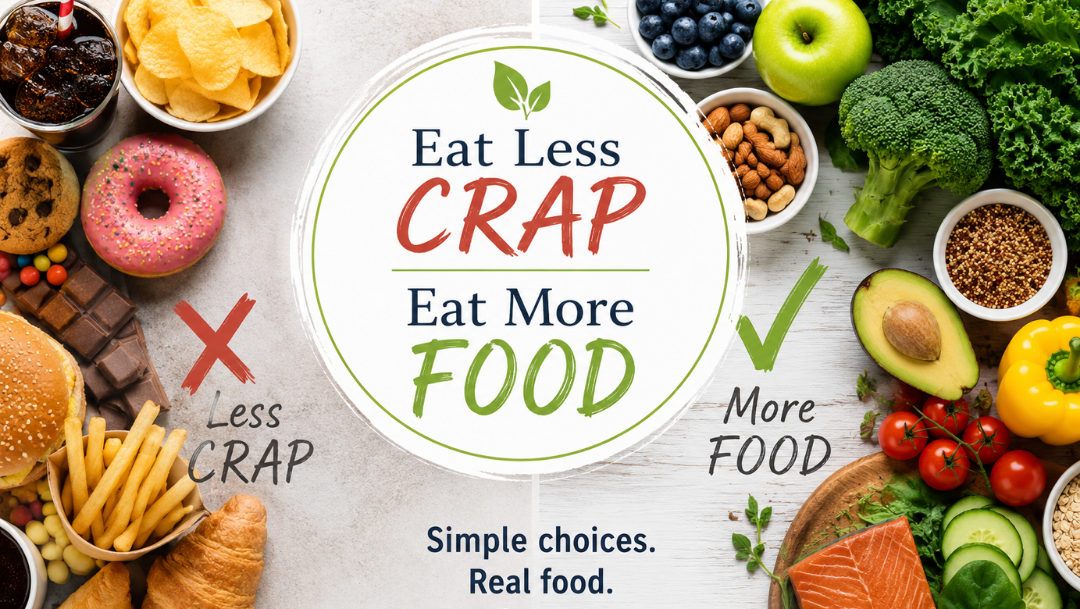
Eat Less Crap
Eat Less CRAP and Eat More FOOD
Here is another article in our Managing Your Menopause series.
Small Changes to What You Eat Can Make a Big Difference
What we eat doesn’t just satisfy hunger. The food we choose provides the raw materials our bodies need to function, and our everyday choices can influence our digestion, energy, metabolism and overall wellbeing.
During midlife, it becomes even more important to pay attention to what we are putting into our bodies.
The good news?
You don’t have to change everything overnight.
Small, realistic changes to what you eat and drink can be a much more manageable way to begin supporting your body and your gut.
Here’s Julia…
Hello, I’m Julia Riewald
I have a lifelong passion for health, nutrition and understanding how the human body works.
One of the things I am particularly passionate about is helping people understand why their everyday choices matter.
I don’t believe simply telling someone, “Eat this,” “Don’t eat that,” or “Drink more water” is enough.
When you understand what is happening inside your body and how the choices you make can affect it, you are in a much better position to decide what feels right for you.
And one of the most important places to start is with your gut.
Your gut and its microbiome play an important role in digestion and metabolism, as well as having connections with your immune system, brain and hormone production.
So, rather than thinking only about eating less or going on another restrictive diet, let’s start by thinking about what we’re actually giving our bodies to work with.
EAT LESS CRAP!
An easy way to remember some of the things you may want to reduce is:
C — Carbonated Sugary Drinks
This includes many fizzy drinks and other heavily sweetened beverages.
Rather than automatically reaching for another sugary drink, start becoming aware of how often you’re drinking them and consider healthier alternatives.
R — Refined Sugars
Think biscuits, cakes, sweets, sugary breakfast cereals and many of the sweet treats that can so easily become part of our everyday routine.
You don’t necessarily have to change everything at once. Start by noticing how much refined sugar is finding its way into your day.
A — Artificial Sweeteners
These can include ingredients such as aspartame, saccharin and sucralose.
Don’t assume that because something is labelled “diet,” “low sugar” or “sugar-free” it automatically makes it the best choice for you.
Read the labels and understand what you’re putting into your body.
P — Processed Foods
Takeaways, ready meals, processed meats, packaged snacks and many convenience foods can form a surprisingly large part of our modern diet.
Convenience has its place, but whenever possible, try moving the balance towards fresher, less processed foods.
Instead, EAT MORE FOOD!
And by FOOD, I mean giving your body more of the nourishment it actually needs.
F — Fruit and Vegetables
Aim for variety and freshness.
Different fruits and vegetables provide different nutrients, so make your plate as varied as you reasonably can.
O — Organic / Quality Sources of Protein
Choose good-quality sources of protein such as meat, fish, eggs, tofu and beans according to your own dietary preferences.
Protein provides important building blocks your body needs throughout life.
O — Omega Fatty Acids
Foods such as oily fish, including salmon and mackerel, as well as nuts, seeds and certain plant oils, can provide beneficial fats as part of a balanced diet.
D — Drink More Water
Water is one of the simplest things we can overlook.
Ask yourself:
How much water am I actually drinking each day?
Rather than trying to achieve perfection immediately, start by making water a more regular part of your daily routine.
Your Gut Is More Important Than You May Realise
Inside your gut lives an enormous community of microorganisms collectively known as your microbiome.
This ecosystem is involved in far more than simply digesting yesterday’s dinner.
It is connected with digestion and metabolism, immunity, brain health and hormone production.
That is why I encourage people to think beyond simply:
“What should I stop eating?”
Instead, ask:
“What does my body need, and what can I give it to help it function at its best?”
Midlife doesn’t have to mean fighting against your body.
It can be an opportunity to understand it better.
Start with small changes.
EAT LESS CRAP.
EAT MORE FOOD.
And start supporting your health from the inside out.
Julia Riewald
Gut Health Expert
Other articles you might be interested in

How do you feel about You?

Life begins at 40 do you agree?
This Post Has 0 Comments